

Why the next phase of AI will be won by governed enterprises
Artificial intelligence has moved quickly from experimentation to execution. Across industries, executives are no longer asking whether AI can improve productivity, customer engagement, software delivery, risk management or decision support. The more important question is whether AI can be scaled safely, consistently and economically across the enterprise.
That question changes the nature of the conversation. AI governance can no longer be treated as a policy document, an ethics statement or a compliance appendix. It must become an operating capability: embedded in platforms, visible to leaders, enforceable in workflows and measurable through data.
This matters because the risk profile of AI is changing. Early generative AI use cases were often narrow and human-supervised: summarising documents, drafting content, generating code snippets or assisting analysts. The emerging wave is more consequential. AI agents can call tools, access enterprise data, interact with applications, trigger workflows and make recommendations that influence real business outcomes. The more useful AI becomes, the more it touches sensitive data, operational processes, customer interactions and regulated decisions.
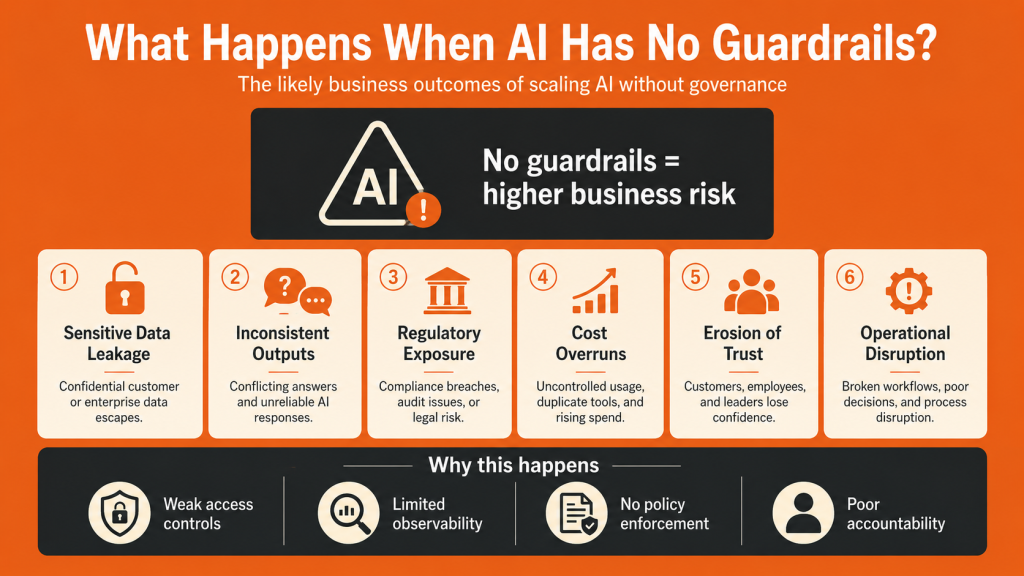
For executive teams, this creates a strategic tension. Move too slowly, and the organisation risks falling behind competitors that are already embedding AI into customer, employee and operational workflows. Move too quickly, without appropriate controls, and the organisation risks data leakage, inconsistent outputs, cost overruns, reputational damage, regulatory exposure and loss of trust.
AI governance is the discipline that resolves this tension. Done well, it does not slow innovation. It creates the conditions under which innovation can scale.
AI guardrails are necessary, but not sufficient
A useful way to think about AI governance is through the concept of guardrails. In business terms, guardrails are the controls that keep AI systems operating within acceptable boundaries. They help ensure that AI tools reflect the organisation’s standards, policies, risk appetite and values.
In practical terms, guardrails can check prompts, filter outputs, block unsafe content, detect personally identifiable information, enforce approved usage patterns and flag exceptions for human review. They may be applied before a request reaches a model, after a model produces a response, or at multiple points across a workflow.
But guardrails should not be mistaken for governance in its entirety. They are a critical control layer, not the whole system. Just as financial controls do not eliminate the need for risk management, audit, accountability and executive oversight, AI guardrails do not remove the need for broader governance architecture.
A mature AI governance model requires five reinforcing elements:
| Governance element | Executive question it answers |
|---|---|
| Policy and standards | What types of AI use are acceptable, restricted or prohibited? |
| Access and permissions | Who can use which models, agents, data and tools? |
| Guardrails and controls | What should be blocked, masked, filtered, escalated or logged? |
| Observability and audit | What is being used, by whom, at what cost and with what outcome? |
| Accountability and assurance | Who owns AI performance, risk, compliance and remediation? |
This is where many organisations are currently underprepared. They may have AI principles, procurement rules or acceptable-use policies, but lack the operational control plane to enforce them consistently across teams, tools and providers.
The result is fragmented AI adoption. Different business units use different models. Developers connect directly to external providers. Teams build prototypes without consistent logging. Costs become difficult to attribute. Sensitive data can be exposed in prompts. Risk teams struggle to see what is happening. Leaders are left with an uncomfortable trade-off between enabling innovation and maintaining control.
That trade-off is not sustainable.
The governance challenge is shifting from models to the AI estate
In traditional analytics and machine learning environments, governance often focused on data lineage, model development, approval workflows and deployment controls. These remain important. However, generative AI and agentic systems introduce a broader governance surface.
An organisation’s AI estate now includes foundation models, open-source models, custom models, vendor-hosted models, internal agents, external agents, coding assistants, retrieval pipelines, vector databases, APIs, prompts, evaluation datasets, monitoring logs and tool integrations. Increasingly, AI systems also interact with Model Context Protocol servers and other mechanisms that allow agents to access tools and enterprise context.
This diversity creates a practical governance problem. If each model, agent or tool is governed separately, control becomes inconsistent and expensive. If governance is imposed manually, it cannot keep pace with adoption. If controls are too restrictive, users bypass them. If controls are too loose, risk accumulates invisibly.
The answer is to govern AI traffic through a centralised, platform-based layer. This is the architectural shift represented by capabilities such as Databricks Unity AI Gateway. The strategic point is not simply that organisations need another technical component. It is that AI governance increasingly requires a common layer through which AI requests can be controlled, observed, routed, logged and improved.
For executives, the analogy is familiar. Cybersecurity matured when organisations moved from ad hoc controls to centralised identity, access management, endpoint protection, logging and security operations. Data governance matured when organisations moved from spreadsheet-based catalogues to integrated data platforms, lineage, access controls and auditability. AI governance is now moving in the same direction.
It needs to become part of the enterprise operating fabric.
What an AI gateway changes
An AI gateway acts as an enterprise control point between users, applications, agents and the underlying models or AI services they consume. Instead of every application connecting separately to different model providers, requests flow through a governed layer where policies can be applied consistently.
This has several practical implications.
First, it simplifies access. Teams can work with different models through a standardised interface rather than building and maintaining bespoke integrations. This reduces friction for developers while giving the organisation a clearer view of what is being used.
Second, it strengthens control. Permissions, rate limits, traffic routing, PII filters, safety filters and policy-driven restrictions can be applied centrally. This makes governance more enforceable and less dependent on individual teams remembering to implement controls correctly.
Third, it improves observability. Usage, cost, request logs, response logs and performance patterns can be monitored across models and applications. For executives, this means AI adoption can be managed with evidence rather than anecdote.
Fourth, it supports resilience and optimisation. Traffic can be routed across models, fallbacks can reduce service disruption, and A/B testing can compare performance across different model choices. This matters because model selection is no longer only a technical decision. It affects cost, quality, latency, risk and customer experience.
Finally, it creates an audit trail. In regulated industries, the ability to reconstruct who used an AI system, what was submitted, what was returned, what controls were applied and what exception handling occurred is essential. Without this evidence, AI assurance becomes difficult to defend.
Guardrails must match the risk of the use case
A common mistake is to apply the same governance model to every AI use case. This creates two problems. Low-risk use cases become overburdened, slowing adoption. High-risk use cases remain undercontrolled, creating exposure.
Executives should instead adopt a tiered governance model based on business impact, autonomy, data sensitivity and external exposure.
| AI use case type | Typical examples | Governance emphasis |
|---|---|---|
| Low-risk productivity | Drafting, summarisation, internal brainstorming | Acceptable-use policy, user education, basic logging |
| Internal decision support | Analyst copilots, knowledge assistants, code generation | Access controls, source grounding, monitoring, usage tracking |
| Customer or employee interaction | Service chatbots, HR assistants, sales support | Safety filters, PII controls, tone and quality checks, escalation paths |
| Regulated or high-impact workflow | Credit, fraud, complaints, compliance, financial advice | Strong auditability, human approval, model evaluation, exception management |
| Agentic execution | Agents that call tools, update systems or trigger workflows | Runtime controls, permissions, approval gates, continuous monitoring |
This approach allows organisations to move quickly where the risk is low and carefully where the risk is material. It also helps leaders avoid the false comfort of treating AI governance as a single enterprise checklist.
The more autonomy an AI system has, the more governance must shift from static approval to runtime control. This is particularly important for agents. A chatbot that answers a question creates one category of risk. An agent that reads data, calls a tool, generates a recommendation and updates a workflow creates another. Governance needs to follow the action, not just the model.
The executive agenda: five moves to operationalise AI governance
AI governance should be led as a business transformation, not delegated solely to technology, risk or legal teams. The organisations that succeed will be those that connect executive intent with operational enforcement.
There are five moves leaders should prioritise.
1. Define the organisation’s AI risk appetite
Leadership teams need a clear view of where AI can be used freely, where it requires oversight and where it should not be used at all. This should be expressed in business language, not only technical policy.
For example, an organisation may allow AI to assist internal productivity tasks, restrict AI use in customer-facing advice, require human approval for regulated decisions and prohibit sensitive data from being submitted to unapproved external models. These decisions should be explicit, communicated and embedded into controls.
2. Establish a governed AI access layer
The organisation should avoid uncontrolled proliferation of direct model integrations. A central gateway or equivalent control layer provides a practical mechanism for standardising access, enforcing permissions, monitoring usage and applying guardrails.
This does not mean every AI use case must use the same model. In fact, the opposite is true. A well-designed governance layer allows teams to use the right model for the right job while ensuring that usage remains visible and controlled.
3. Build guardrails into the workflow, not around it
Guardrails are most effective when they are embedded in the path of AI usage. PII detection, unsafe-content filtering, masking, blocking, rate limiting and logging should occur as part of normal execution. If governance relies on after-the-fact review alone, it will be too slow and incomplete.
This is particularly important for sensitive data. Organisations need to know whether prompts and responses contain names, addresses, account details, payment information, health information, confidential business data or other protected content. Where necessary, that data should be blocked or masked before it creates downstream exposure.
4. Measure usage, cost, quality and risk together
AI creates value only when it is used effectively. But usage without visibility can become expensive and risky. Leaders need dashboards that show adoption, cost, model consumption, business use case, user group, error rates, safety events and exceptions.
This is not simply a finance issue. Cost visibility helps the organisation understand which use cases are scaling, which models are efficient, and where demand needs to be managed. Quality visibility helps teams determine whether AI outputs are improving or deteriorating. Risk visibility helps compliance, audit and operational leaders identify where intervention is needed.
5. Create clear accountability for AI outcomes
AI governance requires named ownership. Business owners should be accountable for use-case outcomes. Technology leaders should be accountable for architecture, security and operational reliability. Risk and compliance leaders should be accountable for assurance and control design. Data leaders should be accountable for data access, lineage and quality. Executive committees should oversee prioritisation, funding and risk appetite.
Without this operating model, AI governance becomes a set of disconnected activities. With it, governance becomes a repeatable capability.
Governance is also a value lever
It is tempting to position AI governance as defensive: a way to prevent harm, satisfy regulators and reduce risk. That is true, but incomplete. Good governance is also a value lever.
It accelerates adoption because teams can build within approved pathways rather than negotiating controls from scratch. It improves trust because customers, employees and regulators can see that AI is being managed responsibly. It reduces duplication because common services, controls and patterns can be reused. It improves financial discipline because usage and cost are visible. It supports innovation because experimentation can occur inside safe boundaries.
In many organisations, AI adoption is currently constrained less by model capability than by confidence. Executives are interested, employees are experimenting, and vendors are moving quickly. What is often missing is the institutional confidence to scale AI beyond pilots.
Governance creates that confidence.
The board-level question
The board and executive team do not need to understand every technical detail of model routing, prompt filtering or inference logging. But they do need to ask sharper questions:
- Are we able to see all material AI usage across the organisation?
- Can we control which users, applications and agents access which models and data?
- Can we detect and prevent sensitive information from being exposed through AI prompts or responses?
- Can we audit AI interactions after the fact?
- Can we attribute AI cost to business units, use cases or products?
- Do our controls differ based on risk, autonomy and regulatory exposure?
- Do we have accountable owners for AI performance, safety and remediation?
- Can we scale AI without creating unmanaged operational risk?
If the answer to these questions is unclear, the organisation does not yet have AI governance at enterprise scale.
The path forward
AI governance is entering a more practical phase. The discussion is moving from principles to platforms, from aspiration to enforcement, and from experimentation to enterprise operations. Guardrails remain central, but they need to be part of a broader control architecture that includes access, observability, audit, cost management, workflow integration and executive accountability.
The organisations that lead in AI will not be those that simply adopt the most models or launch the most pilots. They will be those that build the capability to use AI repeatedly, safely and at scale.
In that sense, AI governance is not a brake on transformation. It is the mechanism that makes transformation durable.
The executive challenge is therefore clear: move AI governance out of the policy drawer and into the operating model. Put controls where AI is actually used. Make usage visible. Align guardrails to business risk. Give teams safe pathways to innovate. And ensure that as AI becomes more capable, the organisation becomes more governable.
That is how enterprises will turn AI from a promising technology into a trusted business system.